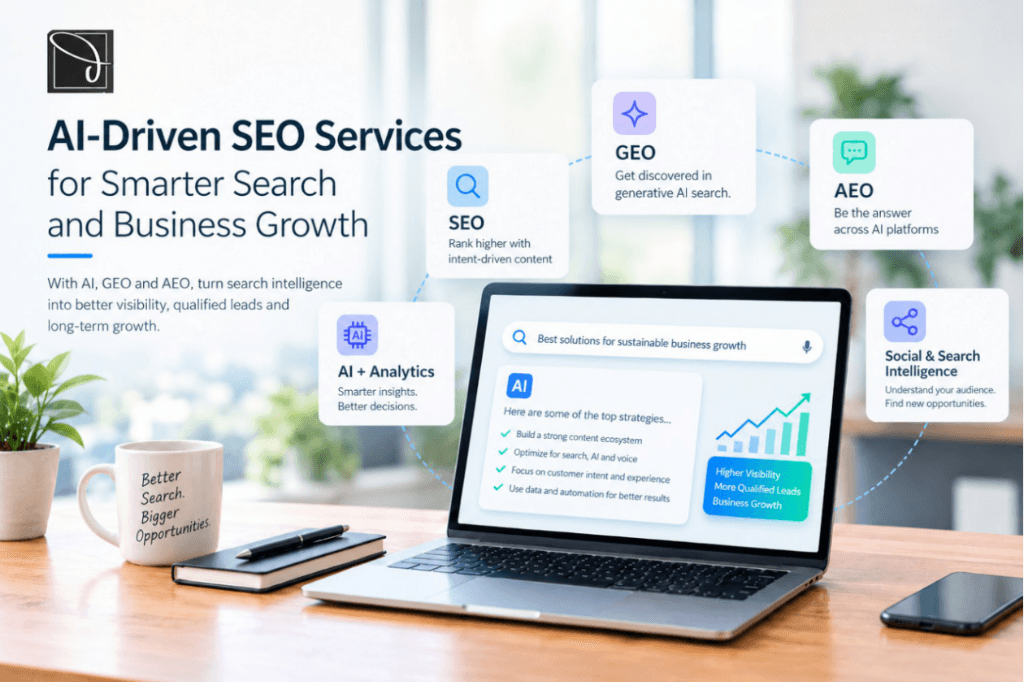
SEO Is No Longer Just a Traffic Channel
Traffic has always been an important SEO metric. But traffic alone does not tell the complete story.
A thousand visitors who are only looking for general information may be less valuable than a hundred visitors actively evaluating a solution.
This is why modern SEO needs to begin with business intent.
What are customers trying to solve? What information do they need before contacting a company? What questions appear during the research stage? Which topics indicate genuine buying intent? Where are competitors gaining attention? And which gaps in the current customer journey are preventing visitors from becoming leads?
AI can help answer these questions by processing large volumes of search, audience, competitor, and performance data. It can identify patterns that would take considerably more time to uncover manually.
But the technology is only one part of the equation.
The real value comes from combining those insights with marketing experience and business understanding.
From Search Intelligence to Marketing Intelligence
Search data tells us what people are looking for. Marketing intelligence helps us understand why it matters.
This distinction is becoming increasingly important.
Suppose search data shows growing interest in a particular business problem. A traditional SEO approach may simply create an article targeting the related keyword.
A more strategic approach asks what happens next.
Does this search represent an early-stage researcher or a potential buyer? What concerns might this person have? What information would help them compare solutions? What proof would increase their confidence? What should they see after reading the article?
These questions connect SEO with the wider marketing and sales journey.
Digixito's Social & Search Intelligence offering is built around this broader perspective. Rather than treating search optimization as an isolated activity, it brings together audience behavior, search signals, AI-powered analysis, and marketing strategy.
The objective is not to generate traffic for the sake of traffic.
It is to identify opportunities that can contribute to business growth.
Where GEO and AEO Fit Into Modern Search
The rise of generative AI has changed the search experience itself.
People can now ask more detailed, conversational questions and receive synthesized answers instead of working through multiple search results. Google has also expanded its generative AI experiences in Search, creating additional ways for users to discover information and websites.
This has brought GEO and AEO into the conversation.
Generative Engine Optimization (GEO) focuses on improving how a brand and its information can be understood within generative search experiences. Answer Engine Optimization (AEO) focuses on creating content that directly and clearly addresses the questions people ask.
But there is an important distinction.
GEO and AEO should not be treated as shortcuts around SEO. Google's own guidance explains that its generative AI search experiences continue to rely on core Search systems and that fundamental SEO practices remain relevant.
In practice, this means businesses should focus on the fundamentals first:
Create original and genuinely useful information.
Demonstrate real subject expertise.
Organize content so important information is easy to understand.
Address the questions customers actually ask.
Maintain consistent information about the brand.
Build strong internal relationships between related topics.
Keep the website technically accessible.
Review content for accuracy and usefulness.
Use data to understand what is working and what needs improvement.
The goal is not to create one version of content for Google, another for AI platforms, and another for customers.
The goal is to build one strong digital knowledge base that works for all three.
AI-Enhanced SEO/GEO/AEO Needs Human Expertise
There is a common misconception that
AI-Enhanced SEO/GEO/AEO means automating content production.
It doesn't.
AI can make research, analysis, pattern recognition, reporting, and optimization more efficient. But strategy still requires people who understand the market, the customer, the brand, and the commercial objective.
This is where a multidisciplinary approach becomes valuable.
Digixito has built its capabilities across digital marketing, web development, design, branding, AI/ML, automation, and digital transformation. Its broader AI in Marketing & Growth practice focuses on using data and artificial intelligence to improve targeting, customer understanding, campaign optimization, and measurable growth.
That combination matters because search does not operate independently from the rest of a digital business.
A technically strong website with weak messaging will struggle to convert.
Excellent content without a clear customer journey may generate attention without creating opportunities.
Strong traffic without conversion optimization may increase numbers without improving revenue. The real advantage comes from connecting these pieces.
What This Means for Marketing and Sales Teams
For marketing leaders, the shift toward AI-enhanced search creates an opportunity to bring SEO closer to business strategy.
Instead of reporting only rankings and organic sessions, teams can start looking at a wider set of commercial signals:
Visibility → Engagement → Qualified Traffic → Leads → Conversions → Revenue
This also changes the conversation between marketing and sales.
Search insights can reveal the questions prospects are asking before they contact a business. Content can then be developed to address those questions earlier in the buying journey.
Sales teams can also benefit from understanding which topics, services, and problems are generating interest.
When marketing and sales use the same customer intelligence, SEO becomes more than a content channel. It becomes a source of market insight.
Building Search Strategies That Can Adapt
One of the biggest limitations of traditional SEO is the assumption that a strategy can be created once and then followed indefinitely.
Search does not work that way.
Customer behavior changes. Competitors change their messaging. New search experiences appear. Existing content becomes outdated. Market demand shifts.
AI makes it possible to monitor more of these changes and respond faster. A practical cycle looks like this:
Research: Discover audience queries, intent shifts, and content gaps.
Intelligence: Analyze search trends, competitor movements, and emerging patterns.
Strategy: Align keyword and topic opportunities with commercial business goals.
Content: Produce authoritative, genuinely helpful, and human-crafted resources.
Optimization: Ensure fast technical delivery, clear structure, and crawlability.
Measurement: Monitor pipeline quality, conversion paths, and user satisfaction.
Learning: Feed performance signals back into subsequent strategic choices.
The important word is learning.
Every performance signal should help improve the next decision. If a page receives impressions but few clicks, its positioning may need attention. If it receives traffic but generates no enquiries, the problem may be relevance, messaging, user experience, or conversion. If a particular topic starts attracting qualified prospects, it may deserve deeper content and stronger commercial pathways. This is how SEO becomes an ongoing growth discipline rather than a one-time campaign.
Why Digixito Takes a Broader View of Search
Digixito's approach to digital growth has developed across multiple disciplines rather than SEO alone. The company's capabilities span AI transformation, business transformation, product engineering, design intelligence, digital marketing, and growth.
That broader perspective is increasingly relevant to search.
Today, the companies that win visibility are not necessarily those that publish the most content. They are the ones that understand their market, communicate their expertise clearly, create useful experiences, and respond to changing customer behavior.
This is also why Social & Search Intelligence sits naturally within Digixito's AI in Marketing & Growth offering. The focus is on connecting intelligence with action—using data to understand the market, AI to improve decision-making, and marketing expertise to turn those insights into meaningful growth opportunities.
The Future of SEO Is More Human, Not Less
AI is changing how people search, but it has not changed what makes a business credible. People still want useful answers.
They still want evidence.
They still want to understand whether a company knows what it is talking about.
And before making an important purchase, they still want confidence that they are choosing the right partner.
That is why the future of SEO will not simply belong to businesses that use more AI. It will belong to businesses that use AI with better strategy, better information, stronger expertise, and a clearer understanding of their customers.
Conclusion
Search is moving from a simple ranking environment toward a broader discovery ecosystem shaped by search engines, social platforms, conversational experiences, and generative AI.
For businesses, this creates both a challenge and an opportunity.
The challenge is that visibility can no longer be managed through keywords and rankings alone. The opportunity is that search data, AI, marketing intelligence, GEO, AEO, content, and conversion strategy can work together to create a much clearer picture of the customer and the market.
At Digixito, this broader perspective is reflected in Social & Search Intelligence and the company's wider AI in Marketing & Growth capabilities. The focus is not simply on helping a business appear in search, but on understanding where its audience is looking, what they need, and how digital visibility can contribute to meaningful business outcomes.
The next generation of SEO will be less about chasing algorithms and more about understanding people, markets, and intent—and using technology intelligently to act on that understanding.
For businesses ready to make that shift,
AI-Driven SEO Services provide a practical foundation for building search visibility that is more intelligent, adaptable, and connected to long-term growth.